Eigenmoon
Linear algebra by moonlight: a game of transformations.

AI interpretability research and applications.
I design algorithms that allow humans to understand machine learning models: what they learn from their training data, how they make predictions, and where they might fail in unexpected ways.
Previously I built and interpreted models on histopathology data for cancer diagnostics, and did my PhD on model-agnostic interpretability (methods that explain a model's decisions without needing to see inside it).
Since then I've worked on AI interpretability for: failure modes of large language models (one of those, a set of tokens that broke GPT-3, made the news); scientific discovery (if a model can predict something you can't, it knows something you don't); and high-stakes applications for financial institutions where understanding model behaviour is critical.
I live in San Francisco.
I've been on a few podcasts, including Latent Space, The Human Podcast and Tech Brew Ride Home, done a live session with Presence, and pitched Leap at Deep Tech Momentum. Vice and Futurism covered my glitch-token research, which now has its own Wikipedia page.
I've published interpretability methods, tools, and applications to scientific and language data: from Exemplar Partitioning, a new way to find meaningful structure in activation space, to Open Problems in Mechanistic Interpretability, a field-wide survey I co-authored with researchers from Anthropic, Google DeepMind, MIT and others.
Linear algebra by moonlight: a game of transformations.
Model risk and compliance teams use Halley to deeply understand their models, surfacing the interactions, subgroup effects, and conditional patterns that other tools miss.
A new method for finding interpretable structure in language models 1000x faster than sparse autoencoders.
Hypothesis-driven analysis can only ever find what you already suspect is there – here is a case for starting with the data instead.
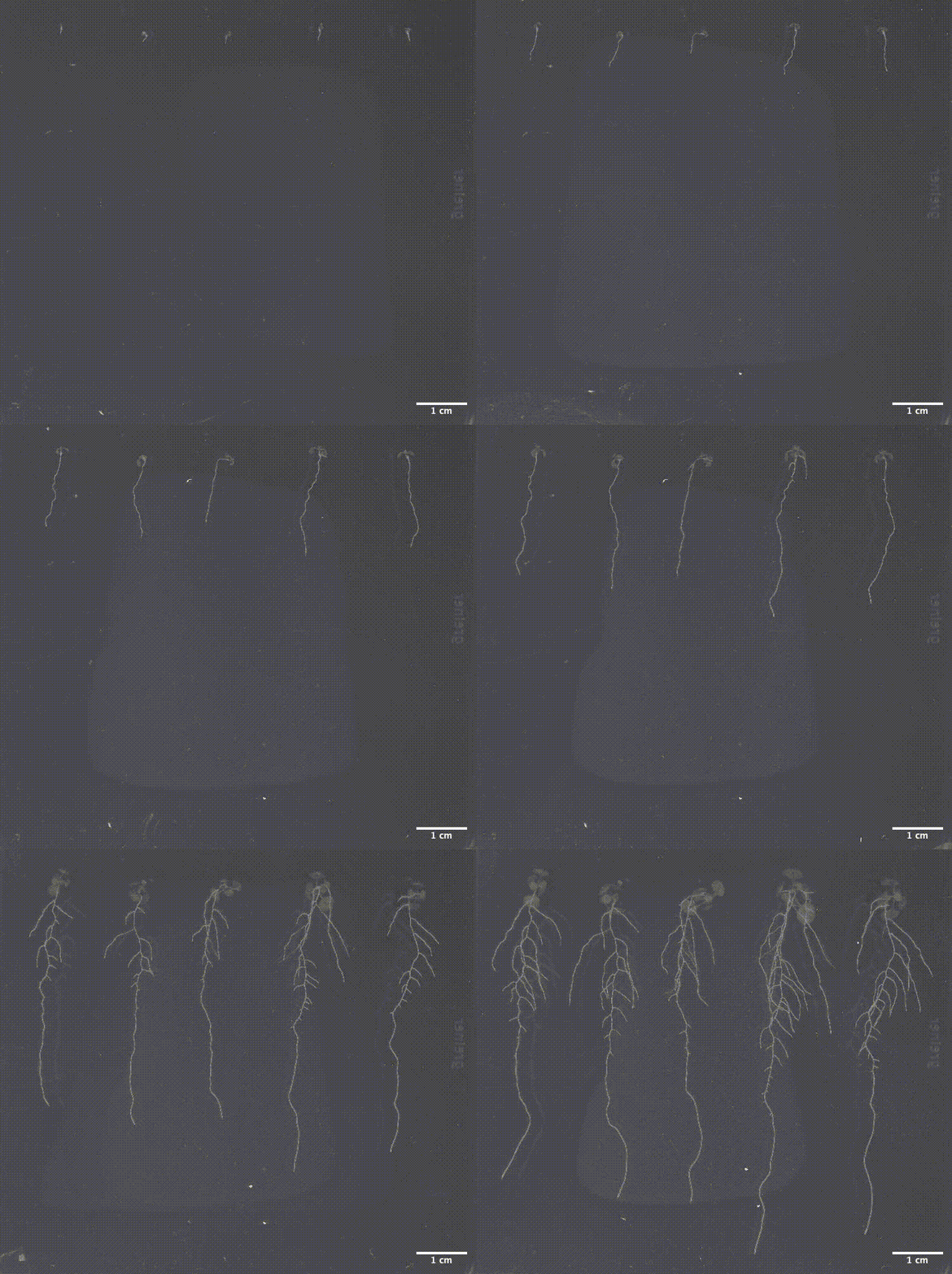
Three publications where models trained on scientific data found novel patterns, and our interpretability methods made them legible. These findings were discovered automatically by Disco and written up with the domain experts who gathered the data.
A survey of how AI is used in science today, from systematic literature review to autonomous agents.
An efficient black-box method for attributing a language model's output back to the parts of the prompt that caused it, even if the model is hidden behind an API.
The glitch-token work: we discovered a set of very strange tokens that made GPT-3 break in unexpected ways.